Key Achievements

2016-2017
Livepeer Founded
  • Doug Petkanics and Eric Tang found Livepeer
  • Mission: decentralize the hardest layer of video infrastructure: transcoding - using crypto-economic incentives.
    Livepeer Whitepaper
2018
Network Launch
  • Livepeer protocol launches on Ethereum.
  • First decentralized marketplace for video transcoding goes live.
    Mainnet Launch
2019-2020
Production Validation
  • Network proves it can deliver lower-cost, reliable transcoding at scale.
  • Orchestrator + delegator model stabilizes supply and quality.
    Architecture & Incentives
2021
Real Adoption
  • Major platforms and apps use Livepeer for production workloads.
  • Livepeer Inc. productizes access (APIs) while the network keeps running permissionlessly.
    Real Adoption
2022
Video-first Conviction
  • Livepeer doubles down on video-native infra, resisting the “generic GPU cloud” path.
  • Early exploration of video + ML workloads.
    Video + ML
2023
AI Integration
  • Livepeer introduces AI-first gateways, combining video & AI workloads.
  • First real-time AI video pipelines demonstrated on the network.
  • Founders outline a vision for AI-first infrastructure.
    AI-first Gateways
2024
Cascade Vision
  • Public articulation of Livepeer’s shift to real-time AI video infrastructure (“Cascade”).
  • Orchestrators upgrade hardware; inference becomes a first-class workload.
    Cascade Vision: AI Video Compute
2025
Foundation LaunchProduct ProofDaydream Launch
  • Livepeer Foundation launched to steward the network’s long-term growth.
  • First Special Purpose Entities (SPEs) formed: AI SPE, Cloud SPE.
  • Daydream launches (real-time AI video creation).
  • ComfyStream / ComfyUI integration enables visual, real-time AI workflows.
  • Majority of network fees now driven by AI inference, not just transcoding.
    Livepeer Foundation
2026
Where Livepeer is Today
  • Livepeer recognized as the open, real-time AI layer for video.
  • Differentiation is clear: low-latency streaming + AI inference at scale, powered by a decentralized GPU network.
    Livepeer Roadmap

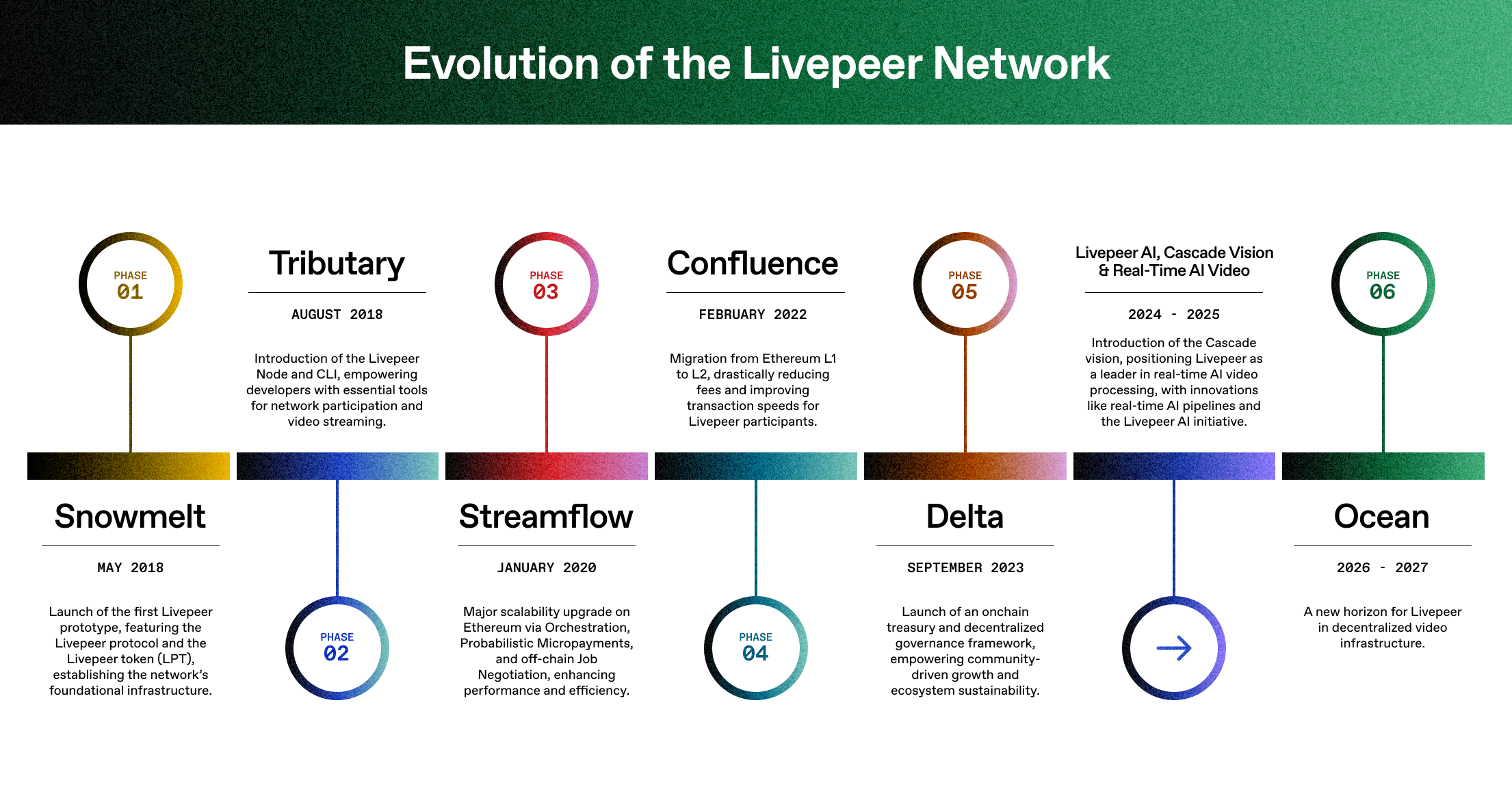
Livepeer Development Stages

Evolution of Livepeer
Livepeer’s development has been marked by six key phases:
Snowmelt
Livepeer Alpha Launches
April 30, 2018
  • Proposed in LIP-1 and went live in April 2018.
  • Marked the launch of Livepeer Alpha on Ethereum mainnet.
  • The first functional version of the network-enabled basic video broadcasting and the generation of LPT rewards from an initial total token supply of 10 million LPT at Genesis.
Tributary
Developer Enabling
Aug. 23, 2018
  • Propsed in LIP-10 and went live in August 2018.
  • Enabled developers to build on Livepeer’s video infrastructure and addressed major pain points identified in the protocol’s first iteration.
Streamflow
Scalability & Micropayments
Jan. 17, 2020
  • Proposed in May 2019 in LIP-30 and went live in January 2020.
  • Expanded the network’s node capacity from 25 to 100, introduced the “Transcoder” role, splitting the original orchestrator role to drive network efficiency and performance.
  • This upgrade also introduced Probabilistic Micropayments and offchain job negotiations.
Confluence
Layer 2
Feb. 15, 2022
  • Initially proposed in September 2021 in LIP-80 and went live in February 2022.
  • This upgrade deployed Livepeer on Arbitrum, moving the protocol’s functionalities to the Layer-2 network.
  • This significantly reduced the protocol’s gas fees and offered faster transactions to network participants.
Delta
Onchain Treasury
Oct. 13, 2023
  • Proposed in April 2023, Livepeer Delta went live in October 2023 following the passing of LIP-91.
  • This upgrade deployed a community-governed onchain treasury for the protocol Livepeer.
  • It also introduced new parameters to Livepeer’s staking contract that routes a portion of LPT’s inflationary emissions to the treasury, which is used to fund Public goods.
Cascade
AI-first Gateways
TBD
  • Proposed in May 2025 in LIP-100.
  • This upgrade introduces AI-first gateways, combining video & AI workloads.
  • Supporting custom AI models and job types, allowing AI developers to utilize its global GPU network for both video-specific and broader applications.
Last modified on February 18, 2026